
Ideological subversion patterns in modern democracies
An INWM Protocol explainer on how narratives, not just events, reshape political life.

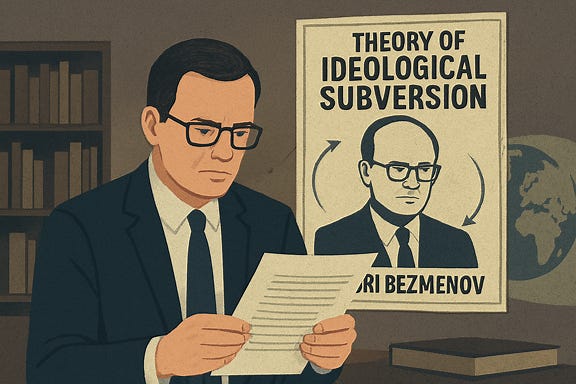
What ideological subversion means in plain language
Ideological subversion refers to long‑term efforts to influence how a society thinks, feels, and interprets reality, usually through information, culture, and institutions rather than direct violence. Analysts often link the term to Cold War “active measures,” psychological warfare, and what some now call cognitive warfare.
Key idea:
The goal is not just to change policies, but to reshape perceptions, values, and loyalties so deeply that people begin to destabilize their own society without needing an external invasion.
The four‑stage model (Bezmenov’s framework)
Former KGB defector Yuri Bezmenov described ideological subversion as a multi‑stage process aimed at gradually undermining a target society. Different sources phrase the stages slightly differently, but the most widely cited structure looks like this:
Demoralization:
A long period (roughly one generation, often cited as about 15–20 years) in which education, media, and culture are influenced to erode confidence in a society’s own institutions, history, and values.Destabilization:
Focused pressure on key sectors such as the economy, foreign relations, and internal security to increase polarization and institutional friction.Crisis:
A sharp event or series of events (political, economic, social) that pushes society into acute conflict or confusion.Normalization:
The new situation, however degraded or unstable, becomes accepted as “just the way things are,” often under a new narrative or power arrangement.
Modern analysts note that this model overlaps with today’s concerns about online disinformation, polarization, and external influence campaigns, even if the actors and technologies have changed.
How INWM Protocol analyzes ideological subversion
INWM (Information–Narrative–Weight Mapping) doesn’t decide who is “good” or “bad.” It asks a different question:
How are information flows, narratives, and emotional weight working together to change how people interpret their society?
Under INWM, ideological subversion is examined through four layers:
Information layer
What’s tracked:
Public signals — news, speeches, laws, social‑media campaigns, cultural products, and institutional actions.INWM question:
What is actually happening and being said, as concretely as possible?
Narrative layer
What’s tracked:
Stories people tell about those signals — for example, “the system is rigged,” “everything is fine,” “collapse is imminent,” “only our group cares about the truth.”INWM question:
Which repeating storylines are forming around these events and signals?
Weight layer
What’s tracked:
The emotional and cultural gravity of those narratives: fear, anger, humiliation, pride, hope, apathy.INWM question:
How intense, widespread, and sticky are these narratives in people’s emotional lives?
Mapping layer
What’s tracked:
How information, narratives, and emotional weight interact over time — especially across election cycles or generational shifts.INWM question:
Do these patterns resemble long‑cycle subversion — demoralization, destabilization, crisis, normalization — regardless of who benefits?
This allows you to study ideological subversion as a pattern of narrative and emotional movement, not as a label for one side.
How ideological subversion shows up in modern democracies
Without naming specific leaders or parties, modern democracies show several recurring patterns that match what researchers describe as ideological or cognitive subversion:
Information saturation and confusion:
Label: Too much information, not enough clarity
People are bombarded with conflicting claims, conspiracy theories, partisan media, and low‑trust social feeds. The result is not better understanding, but paralysis and cynicism — a classic demoralization effect.Polarized narrative ecosystems:
Label: Parallel realities
Different groups live in different narrative universes, with separate “facts,” heroes, and villains. Common ground shrinks, and every issue becomes an identity test, feeding destabilization.Erosion of institutional trust:
Label: Nobody believes the referee
Courts, elections, media, science, and public agencies increasingly become targets of suspicion. Once the referees are distrusted, every conflict feels existential, and crisis becomes easier to trigger.Normalization of permanent emergency:
Label: Crisis as a background condition
Constant talk of civilizational collapse, traitors, and enemies — sometimes from multiple sides at once — makes people adapt to a state of near‑permanent emergency. This is a form of “new normal” that matches the normalization stage.
These patterns can be driven by internal actors, external actors, or both. INWM doesn’t assign blame by default; it tracks how the pattern functions.
Why this matters for citizens, not just governments
Ideological subversion is often discussed as something states do to each other, but in a media‑saturated democracy it also becomes something citizens unknowingly participate in:
By amplifying narratives they haven’t fully examined.
By treating opponents as enemies rather than neighbors.
By accepting confusion as inevitable instead of demanding clarity.
In that sense, the real battleground is not just parliaments, courts, or elections — it’s the narrative environment people live inside every day.
INWM’s role is to give people a way to:
see the pattern
separate signals from noise
recognize when they’re being pulled into demoralization or manufactured crisis
and rebuild clarity and shared understanding at the local level.
That’s where projects like First State Observer and tools like NCI‑24 live: not in deciding who is right, but in making the environment readable again.
Fuel the Mission
This work is reader‑powered.
If you want to help expand INWM Protocol with NCI‑24 (Information–Narrative–Weight Mapping Protocol & News Cycle Intelligence – 24hr scan) and support clarity journalism in Delaware, you can contribute here: paypal.me/srawding74
🧠 Glossary of Terms
Ideological Subversion
A long‑term strategy to reshape a society’s values, perceptions, and loyalties through cultural, educational, and informational influence rather than direct force.Demoralization
The first stage of ideological subversion, involving erosion of confidence in a society’s institutions, history, and values over a generation.Destabilization
The second stage, where pressure is applied to key sectors (economy, foreign policy, internal security) to increase polarization and institutional friction.Crisis
The third stage, marked by acute events that push society into confusion, conflict, or breakdown.Normalization
The final stage, where the new degraded or unstable condition is accepted as the societal baseline.Narrative Ecosystem
The full set of stories, beliefs, and emotional frames circulating in a society that shape how people interpret events and institutions.Information Saturation
A condition where the volume of conflicting or low‑trust information overwhelms the public’s ability to discern truth, leading to paralysis or cynicism.INWM Protocol (Information–Narrative–Weight Mapping)
A clarity framework that analyzes how information signals, narrative structures, and emotional gravity interact to shape public perception.Narrative-Cycle Intelligence (NCI‑24)
A 24‑hour scan module within INWM that identifies dominant narrative tracks, emotional centers of gravity, and public‑impact patterns in daily news cycles.Active Measures
Soviet‑era term for covert influence operations including disinformation, propaganda, and psychological manipulation.Cognitive Warfare
A modern term for strategic manipulation of perception, belief, and decision‑making through information and psychological tactics.